Why Exit Velocity and Launch Angle Don’t Tell the Whole Story
Two baseballs do not have to have the same exit velocity and launch angle to both be home runs. Exit velocity measures how fast the ball leaves the bat, while launch angle measures the vertical angle at which the ball is hit. These two factors work together, but there is not one specific combination that guarantees a home run. For example, one ball might leave the bat at 105 mph with a 25-degree launch angle, while another might leave at 95 mph with a 30-degree launch angle. Depending on other factors, such as where the ball is hit and the conditions of the stadium, both could still result in home runs.
NoteReal-World Example: Same Launch Angle, Very Different Outcomes (2025)
- Alex Bregman (Fenway Park): Hit a 316-foot home run with an exit velocity of 91.2 mph and a 31° launch angle — just sneaking past Fenway’s famous Pesky Pole in right field.
- Nick Kurtz (Sutter Health Park): Smashed a 493-foot blast at 115.0 mph with almost the exact same launch angle (30°).
Both balls had optimal launch angles (~30°–31°), yet their distances differed by nearly 180 feet because of exit velocity and ballpark dimensions.
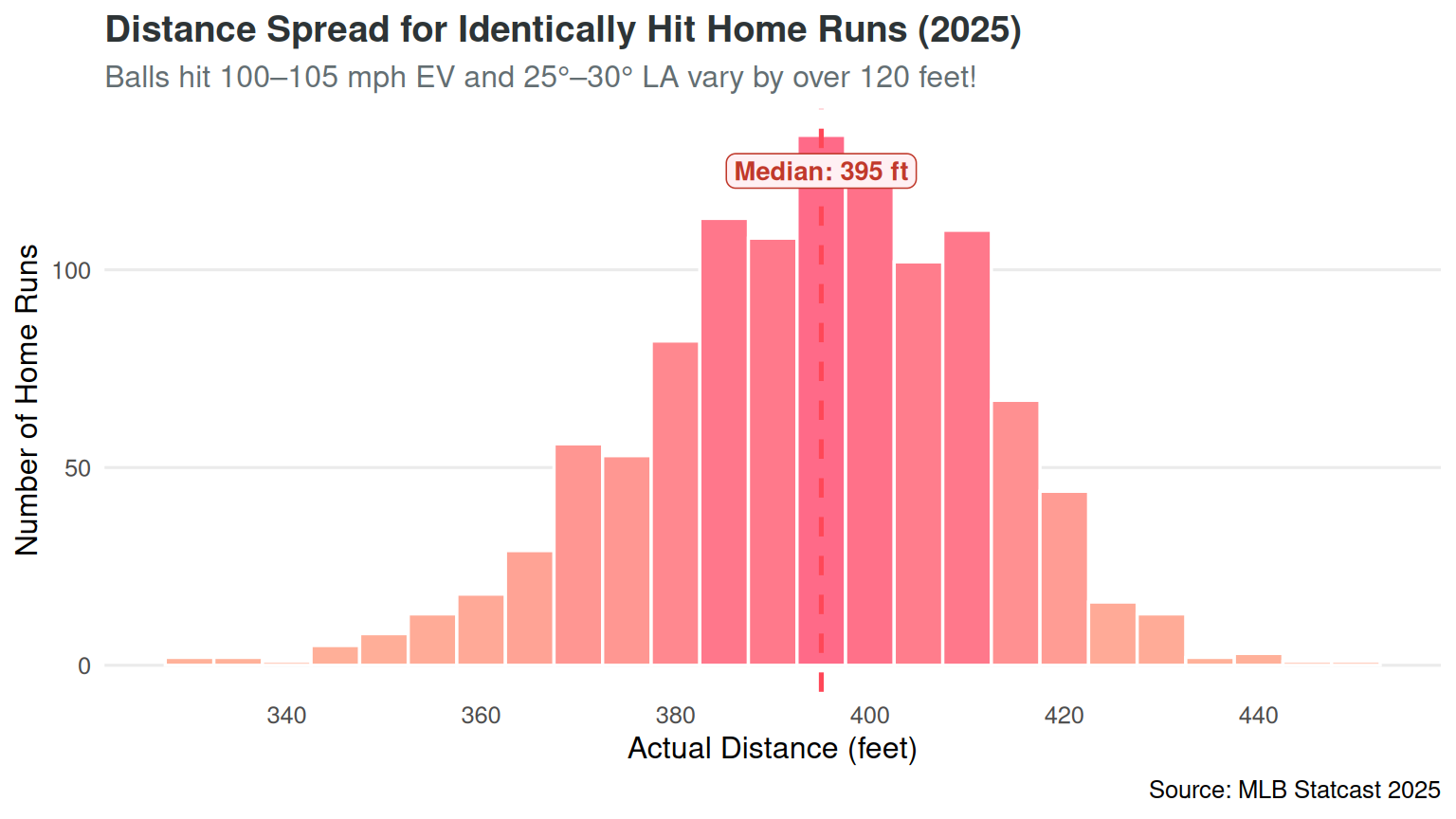
Distance Variation in the “Sweet Spot”
Even when two balls are hit squarely into the ideal home run zone—between 100–105 mph exit velocity and 25°–30° launch angle—environmental conditions, ballpark dimensions, and spray direction cause actual travel distances to vary dramatically: